
-
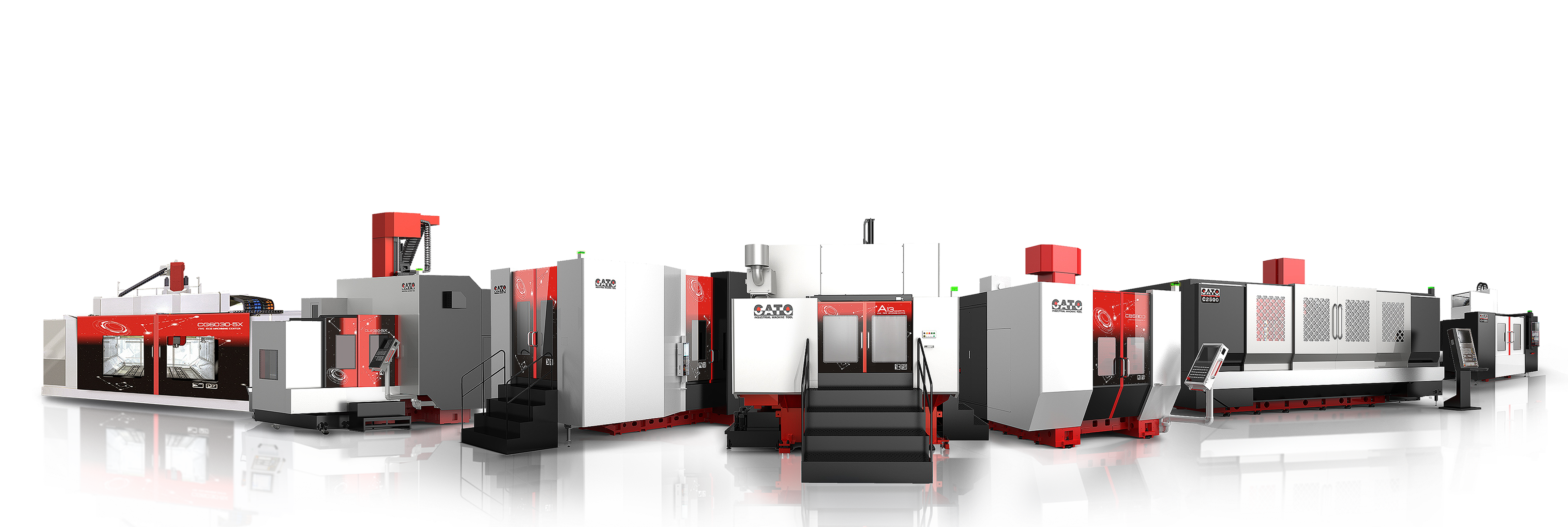
CL Series High Speed Vertical Machining Center CL Series High Speed Gantry Machining Center CHS Series High-speed Removal Machining Center CS Series Gantry Machining Center CT Series Drilling & Milling Machining CenterCP Series Five-axis Horizontal Swing Head Machining Center GF Series Five-axis Fixed Beam Gantry Machining Center CBS Series Five-axis Bridge Machining Center CV Series Five-axis Vertical Machining Center A Series Five-axis Horizontal Cradle Machining Center C Series Five-axis Column Vertical Machining Center GE Series Five-axis Crane Machining Center


Five-Axis CNC Machining Center: Core Application Advantages and Technical Value in Aerospace Manufacturing
Release time:
2026-03-16
Author:
CATO
Source:
Internet
Aerospace manufacturing has stringent machining requirements. CATO's 5-axis CNC machining centers leverage the core technology of 5-axis linkage to achieve high-precision machining in a single setup. They feature remarkable advantages in precision, efficiency and complex part machining, adapt to various aerospace materials and components, have mature application cases, serve as core equipment in this field, and support automated production.


As a core sector of high-end manufacturing, the aerospace industry is rapidly upgrading towards lightweight, precision, and high-efficiency directions, imposing stringent standards on the machining accuracy, structural complexity, and material adaptability of aerospace components. Five-axis CNC machining centers, leveraging the core technological advantage of multi-axis simultaneous linkage, have become key equipment for achieving high-precision machining, complex-shaped part machining, and high-efficiency mass production in aerospace manufacturing. Their comprehensive performance in tolerance control, surface finish, and production efficiency perfectly aligns with the machining requirements of critical aerospace components. When integrated with industrial intelligent technologies, they further empower aerospace manufacturers to enhance quality and efficiency, solidifying their competitive edge in the high-end manufacturing sector.

Key Points
- Five-axis CNC machining centers, utilizing five-axis simultaneous linkage control comprising X/Y/Z linear axes and A/B/C rotary axes, enable high-precision machining of aerospace components in a single setup. They precisely control machining tolerances, ensure precision stability in mass production, and meet the stringent standards of aerospace manufacturing.
- Centered on reducing setup times, they significantly shorten production hours for complex aerospace components. Coupled with automated operation modes, they deliver multiple benefits: improved machining efficiency, optimized production costs, and shortened delivery cycles.
- Possessing the capability for machining complex-shaped structures, they are perfectly adaptable to advanced aerospace materials such as titanium alloys, aluminum alloys, and composites. They achieve excellent surface finish on machined components and offer strong processing adaptability, fully responding to the technological upgrade demands of the aerospace manufacturing industry.
I. Five-Axis CNC Machining Center: Technical Definition and Core Process Differences
1.1 Core Technical Principle of Multi-Axis CNC Machining
The core technical characteristic of a five-axis CNC machining center is that the cutting tool or workpiece can move in a synchronized manner along five coordinate axes simultaneously. This includes three linear axes (X, Y, Z) and two rotary axes (typically A/B and C), making it a core representative of high-end CNC machining equipment. This motion mode breaks the unidirectional machining limitations of traditional machine tools. Operators can machine complex geometric shapes, irregular structures, and undercut features on aerospace components in a single setup without repeatedly repositioning the workpiece. It can cover most surface machining requirements of the component, achieving the triple effects of time saving, precision improvement, and error reduction during the machining process.
With a five-axis CNC machining center, it is possible to machine arcs, angled surfaces, and deep cavity structures that are difficult or impossible with traditional machine tools. During machining, the cutting tool remains tangent to the workpiece surface, significantly enhancing material removal efficiency and shortening the machining cycle per workpiece. Optimized tool positioning effectively reduces machining vibration, helping to improve the surface finish of the workpiece. Furthermore, the ability to complete all processes in one setup maintains rotational accuracy during machining, which is a core technical requirement for aerospace component machining.
From an equipment type perspective, a tilting-rotary table five-axis machining center allows for tilting and rotating the workpiece, offering high stability and high torque output when machining heavy aerospace components. A swivel-head five-axis machining center achieves machining through spindle rotation, providing greater flexibility when machining small or highly complex aerospace components. Both types support multi-surface machining processes, fully satisfying the various stringent technical standards of aerospace manufacturing.
| Comparison Dimension | 3-Axis CNC Machine Tools | 5-Axis CNC Machining Centers |
| Motion Mode | Cutting tool moves unidirectionally along X, Y, Z linear axes | 3-axis base plus A/B, C rotary axes; tool approaches workpiece from multiple angles with 5-axis linkage |
| Machining Capability | Only processes flat and simple-shaped components; manual repositioning required for multi-face machining | Completes complex geometric/special-shaped structure machining in one setup with superior precision and surface finish |
| Clamping Operation | Multiple setups with manual workpiece repositioning throughout the process | One setup for the entire process, equipped with high-end special fixtures for aerospace |
| Programming Difficulty | Simple programming with short pre-production preparation time | High professional programming requirements, adapted to the precision machining programming needs of aerospace |
| Tool Compatibility | Adapted to general standard machining tools | Compatible with special tools for complex aerospace machining, meeting multi-material machining needs |
| Cost Input | Relatively low procurement and daily maintenance costs | High-end precision equipment with relatively higher upfront procurement and professional maintenance costs |
| Machining Effect | Meets basic component machining needs with average precision | High precision and excellent surface finish, fully complying with the high-end precision machining standards of aerospace |
II. Core Application Advantages of 5-Axis CNC Machining Centers in Aerospace Manufacturing
2.1 Micron-Level High-Precision Machining, Meeting the Stringent Tolerance Standards of Aerospace
Aerospace manufacturing has extremely high requirements for component machining accuracy, as tiny dimensional deviations may affect the operational safety and performance of aerospace products. High-precision machining is a core prerequisite for aerospace component manufacturing. Through the 5-axis synchronous linkage of cutting tools, 5-axis CNC machining centers realize multi-angle machining without workpiece repositioning, effectively reducing machining errors caused by multiple setups and shortening setup time. The machining tolerance can be accurately controlled within ±0.0002 inches, with machining precision far exceeding that of traditional 3-axis and 4-axis machine tools, and achieving micron-level machining precision (error range smaller than the diameter of a human hair).
Equipped with advanced CNC control systems and real-time feedback systems, the equipment can monitor the entire machining process of aerospace components, ensuring that each finished component complies with the stringent technical standards of the aerospace industry; in mass production, it can maintain stable machining consistency, providing a solid guarantee for the reliable use of core aerospace components.
five axis CNC machining centers can achieve high-precision machining of special-shaped bevels, complex curves and hard-to-machine surfaces, and are widely applicable to the production and manufacturing of key aerospace components such as impellers, blisks, aero-engine casings, engine blades and aero-engine structural parts.
2.2 Overall Process Machining Efficiency Improvement, Effectively Shortening the Delivery Cycle of Aerospace Components
Aerospace manufacturing projects have strict requirements for component delivery cycles, and enterprises are constantly faced with the challenge of efficiently completing the production of complex components. Relying on the core feature of completing the entire machining process in one setup, 5-axis CNC machining centers greatly simplify the production process of complex aerospace components, reducing the number of setups from up to 6 times in traditional processes to only 1-2 times, which not only effectively shortens production hours but also minimizes error problems caused by multiple positioning.
Its advantages in improving aerospace manufacturing efficiency are also reflected in five aspects: First, eliminating multiple setup links reduces equipment downtime and speeds up the overall production progress of aerospace components; Second, it can be combined with automated operation modes and precise programming to realize 24/7 uninterrupted equipment operation, maximizing production capacity; Third, it supports rapid prototyping of aerospace components, simplifies the production planning process and effectively shortens the product R&D cycle; Fourth, it improves the tooling fixture changeover speed, flexibly meeting the machining needs of aerospace components with different complex geometric shapes; Fifth, it optimizes cutting speed and tool path planning, further improving material removal rate and single-process machining efficiency.
According to the practical application data of the aerospace manufacturing industry, after enterprises introduce 5-axis CNC machining technology, the delivery cycle of complex aerospace components can be shortened by up to 30%, and production hours can be reduced by 25%-35%; at the same time, the first-pass yield rate of components is significantly improved, and material waste during machining is effectively reduced, achieving dual optimization of the overall operational efficiency and cost control capability of aerospace production lines.
2.3 Adapted to Complex Structure Machining, Precisely Processing Precision Special-Shaped Aerospace Components
To meet the requirements of flight performance, structural strength and lightweight design, most aerospace components are designed with complex contours and compound curved surface structures and subject to stringent geometric tolerance control standards. The efficient machining of such components can only be achieved by 5-axis CNC machining centers. The equipment can complete complex processes such as multi-angle hole machining, lightweight weight reduction cavity machining and precision airfoil structure machining of aerospace components in one setup, perfectly adapting to the special machining needs of aerospace components.
In the actual machining process, multi-face and multi-surface machining of components can be completed without disassembly or re-clamping of workpieces; the 5-axis synchronous linkage motion mode supports the machining of common special structures of aerospace components such as undercuts, deep cavities and compound bevels; at the same time, the equipment is perfectly compatible with advanced machining materials commonly used in the aerospace field such as titanium alloys, aluminum alloys, carbon fiber composite materials and high-end aerospace alloys, fully meeting the manufacturing technology requirements of modern aerospace engineering.
Relying on 5-axis CNC machining centers, enterprises can flexibly produce core aerospace components such as turbine blades, aero-engine casings, equipment housings and fuselage structural parts with high strength-to-weight ratio and rich detailed features. This machining capability has become a core guarantee for enterprises to meet the continuous upgrading of the aerospace manufacturing industry.
2.4 Optimizing Component Surface Quality, Comprehensively Improving Aerospace Machining Quality
The surface finish of aerospace components directly affects the aerodynamic performance, service life and assembly precision of products, and is a core indicator for evaluating the machining quality of aerospace components. By optimizing the relative position between the workpiece and the cutting tool, 5-axis CNC machining centers can be matched with shorter and more rigid special tools for machining, effectively reducing vibration during machining, achieving a smoother surface machining effect, and comprehensively improving the overall machining quality of aerospace components.
Aerospace components machined by this equipment feature excellent surface finish and high consistency in mass production, which can greatly reduce subsequent finishing processes such as manual polishing and precision grinding, further shortening production hours; the mode of completing the entire machining process in one setup minimizes workpiece positioning deviation, ensuring the dimensional accuracy of components and the consistency of machining quality; equipped with advanced Tool Center Point (TCP) control technology, it can adjust the tool state in real time, and always maintain the optimal cutting state even when machining complex curved surface structures, ensuring stable machining effects.
By reducing the number of setups and optimizing tool path planning, the surface quality and operational performance of each aerospace component can meet the highest technical standards of the aerospace industry.
2.5 Reducing Clamping Operations, Improving Equipment Machining Versatility, Adapting to Multi-Category Machining in Aerospace
Taking completing complex component machining in one setup as the core advantage, 5-axis CNC machining centers effectively save the clamping time of aerospace components and reduce human operation errors caused by multiple setups. Through the 5-axis linkage of the tool or workpiece, the equipment can machine the workpiece from almost any direction, boasting extremely strong machining versatility. Enterprises can use a single device to efficiently produce various aerospace components such as turbine blades, valve parts, structural brackets, aero-engine accessories and fuselage connectors, greatly improving equipment utilization rate.
This feature can also bring multiple additional values to aerospace manufacturing: reducing clamping time and human operation errors helps to achieve more stringent tolerance control and better surface finish; the multi-axis synchronous machining mode further guarantees the machining precision of aerospace components while improving production efficiency; the equipment supports in-depth integration with automation systems and unmanned operation modes, improving the consistency of the machining process and overall production capacity.
At the same time, 5-axis CNC machining centers can quickly adapt to new product design schemes and new machining materials in aerospace, endowing enterprise production lines with stronger flexibility and adaptability, and helping enterprises maintain their core competitive edge in the aerospace high-end manufacturing market.
III. Practical Application Cases of 5-Axis CNC Machining Centers in the Aerospace Field
As core high-end equipment for aerospace manufacturing, 5-axis CNC machining center technology has been maturely applied in many practical production projects in the aerospace field and has become the standard equipment for machining core aerospace components. Typical application cases include:
- Applied to the machining of complex wing support structures for fighter aircraft such as the F-16, realizing high-precision and complex structure machining in one setup through 5-axis linkage, ensuring the machining precision and structural strength of wing structures, and meeting the stringent requirements of aerospace military manufacturing.
- In NASA's Orion spacecraft project, the precision hole machining on the curved surface of dome-shaped bulkheads adopted 5-axis CNC machining technology, realizing the precise machining of high-precision hole positions on complex curved surfaces and perfectly meeting the structural design and operational requirements of the spacecraft.
- Providing core component machining support for aerospace whole-machine manufacturing, relying on high-speed, precision and high-efficiency machining capabilities to meet the core component machining needs of thousands of aircraft in the aerospace industry every year, ensuring the progress and quality of whole-machine manufacturing.
At present, leading enterprises in the aerospace field have all introduced 5-axis CNC machining technology, relying on it to realize low-setup and high-precision machining of core components such as turbine blades, aero-engine casings, equipment housings and fuselage structural parts; at the same time, enterprises integrate 5-axis CNC machining technology with industrial automation technology, industrial robot technology and additive manufacturing technology, further improving the overall machining capacity and better meeting the stringent standards of the aerospace manufacturing industry for product quality and performance.
5-axis CNC machining centers have become an indispensable core machining equipment in the aerospace manufacturing field. Relying on the core technical characteristics of high precision, high efficiency, complex structure machining and multi-material adaptability, they provide solid technical support for the production of aerospace components. It is widely recognized in the industry that 5-axis CNC machining technology is an important means to drive technological innovation, reduce manufacturing costs and realize industrial upgrading in the aerospace manufacturing industry, and can effectively adapt to the rising technological and production demands of the aerospace manufacturing industry. Aerospace manufacturing enterprises that introduce this technology can effectively improve their high-end precision machining capabilities and consolidate their market competitive edge in the high-end manufacturing field.
IV. Frequently Asked Questions about the Aerospace Application of 5-Axis CNC Machining Centers
4.1 What common aerospace materials can 5-axis CNC machining centers process?
5-axis CNC machining centers are fully compatible with common materials in the aerospace field such as titanium alloys, aluminum alloys, carbon fiber composite materials, glass fiber reinforced materials and various high-end aerospace alloy materials. These materials are widely used in aerospace component manufacturing due to their characteristics of high strength, light weight, strong durability and corrosion resistance. 5-axis CNC machining centers can realize high-efficiency, high-precision and high-consistency machining of these materials.
4.2 How does 5-axis CNC machining technology improve the machining quality of aerospace components?
5-axis CNC machining technology achieves micron-level high-precision machining through 5-axis linkage, which can accurately control machining tolerances and greatly improve the surface finish of components; at the same time, the machining mode of completing the entire process in one setup reduces manual operation links and multiple positioning errors, ensuring that the machining quality of each aerospace component maintains a high degree of consistency in mass production, and fundamentally improving the overall machining quality of aerospace components.
4.3 Can 5-axis CNC machining centers realize the automated production of aerospace components?
5-axis CNC machining centers can deeply realize the automated production of aerospace components. The equipment can be seamlessly integrated with automated supporting equipment such as industrial robotic arms, automatic pallet changers and intelligent loading and unloading equipment, realizing full-process automated operations such as automatic workpiece loading, unloading, clamping and inspection, greatly improving the automation level of aerospace production lines, realizing continuous unmanned operation, and further improving the production efficiency and machining consistency of aerospace components.

Key words:
Previous Page
Previous Page:
Latest information

Official Wechat
Mobile phone official website
Online Message
Leave your contact information and needs, we will arrange for professionals to contact you
Quick Navigation
Contact Us
Add.: No.1, Dongye Road, Houjie Town, Dongguan City, Guangdong Province, China
Tel: +86-769-38825288
WeChat: CATO54321
Fax: +86-769-38825138
E-mail: marketing@catocnc.cn
Web: http://www.catocnc.com
Service Hotline: +86-400-680-6638