
-
CL Series High Speed Vertical Machining Center CL Series High Speed Gantry Machining Center CHS Series High-speed Removal Machining Center CS Series Gantry Machining Center CT Series Drilling & Milling Machining CenterCP Series Five-axis Horizontal Swing Head Machining Center GF Series Five-axis Fixed Beam Gantry Machining Center CBS Series Five-axis Bridge Machining Center CV Series Five-axis Vertical Machining Center A Series Five-axis Horizontal Cradle Machining Center C Series Five-axis Column Vertical Machining Center GE Series Five-axis Crane Machining Center


"Ten Thousand Years Are Too Long, Seize the Day" – A Chronicle of Independent Revitalization of China's Machine Tool Industry
Release time:
2026-06-27
Author:
CATO
Source:
Internet
In the vast expanse of history, who truly rules the industrial landscape? Machine tools are the hardcore foundation of a manufacturing powerhouse and the lifeline for the self-reliance of high-end industrial chains. Looking back over the past seventy years, China's machine tool industry started from humble beginnings, building its foundation with the "Eighteen Arhats" as a starting point. However, it has long been trapped in a predicament of core technologies being blocked and high-end equipment being monopolized, facing industrial hollowing-out and an absence in the high-end sector. Adversity breeds breakthroughs, and hardship gives birth to new life. Facing overseas technological barriers and long-term blockades, domestic specialized and sophisticated enterprises have risen to the challenge, delving deep into independent R&D and focusing on overcoming core technical difficulties. From assembly and follow-up to independent leadership, from technological subjugation to self-reliance, China's machine tools have undergone a transformative leap. This chronicle provides a complete review of the rise, fall, and breakthrough of China's machine tool industry, documenting the article of local enterprises as they overcome blockades, create core machinery, and forge ahead on the path to high-end intelligent manufacturing.


In the vast expanse of history, who truly rules the industrial landscape? Machine tools are the hardcore foundation of a manufacturing powerhouse and the lifeline for the self-reliance of high-end industrial chains. Looking back over the past seventy years, China's machine tool industry started from humble beginnings, building its foundation with the "Eighteen Arhats" as a starting point. However, it has long been trapped in a predicament of core technologies being blocked and high-end equipment being monopolized, facing industrial hollowing-out and an absence in the high-end sector. Adversity breeds breakthroughs, and hardship gives birth to new life. Facing overseas technological barriers and long-term blockades, domestic specialized and sophisticated enterprises have risen to the challenge, delving deep into independent R&D and focusing on overcoming core technical difficulties. From assembly and follow-up to independent leadership, from technological subjugation to self-reliance, China's machine tools have undergone a transformative leap. This chronicle provides a complete review of the rise, fall, and breakthrough of China's machine tool industry, documenting the article of local enterprises as they overcome blockades, create core machinery, and forge ahead on the path to high-end intelligent manufacturing.

Ⅰ.Seventy Years of Industrial Rise and Fall: From the "Eighteen Arhats" Foundation to Core Components Held Hostage
In the early days of the founding of the People's Republic, the domestic machine tool industry had a weak foundation and could only handle simple equipment repairs. The First Five-Year Plan laid out the machine tool industry, establishing the "Eighteen Arhats" backbone factories (including Shenyang No. 1 Machine Tool Plant, Beijing No. 1 Machine Tool Plant, Qiqihar No. 2 Machine Tool Plant, Shanghai Machine Tool Plant, etc.) along with specialized research institutes. These facilities were assigned to produce lathes, milling machines, boring machines, and heavy-duty machine tools, building a foundational industrial system that could only meet the demand for general manual machine tools.
During the 1960s and 1970s, due to external technological blockades, the industry focused on capacity expansion, while precision manufacturing and CNC R&D stagnated, causing the gap with German and Japanese high-end machine tools to widen continuously. After the reform and opening-up, a "market for technology" policy was implemented, leading to the large-scale import of overseas blueprints, complete machines, and core components. From 2000 to 2011, domestic manufacturing experienced rapid growth, and China's machine tool production and sales soared to first place globally. However, this exposed the problem of industrial hollowing-out: while the machine body could be produced domestically, core components like CNC systems, motor spindles, direct-drive rotary tables, and linear scales were heavily dependent on imports.

Overseas enterprises, leveraging closed-loop algorithms, remote locking capabilities, and precision manufacturing barriers, monopolized the high-end market. Strategic industries such as aerospace, new energy vehicles, and humanoid robotics could only procure expensive imported 5-axis equipment, with long delivery times and high maintenance costs, posing significant risks to the industrial chain's security. After 2012, the industry entered a phase of deep restructuring, characterized by overcapacity in the low-end market and debt restructuring at some state-owned enterprises. A consensus emerged: simple assembly leads nowhere, and independent core technology is the only path to long-term success. Since 2019, domestic machine tools have officially entered a stage of independent breakthrough and revitalization aimed at high-end substitution.
Ⅱ.Four Core Technological Barriers That Have Long Constrained Domestic High-End Machine Tools
For years, the industry has been plagued by four critical bottleneck problems:
CNC System Barrier: Overseas companies monopolize the underlying algorithms for 5-axis RTCP and can remotely lock equipment. Early domestic CNC systems suffered from insufficient operational stability, with noticeable errors in complex curved surface machining.
Precision Function Component Shortcomings: High-precision components such as direct-drive rotary tables, high-speed motor spindles, and closed-loop linear scales have long relied on imports. Domestic alternatives often experience elevated temperatures during high-speed machining, leading to precision drift during prolonged cutting, failing to meet sub-micron machining standards.
5-Axis Simultaneous Linkage Algorithm Blockade: Dynamic error compensation and high-speed look-ahead control technologies are blocked. Domestic equipment tends to produce vibration marks or overcutting when machining complex parts like aerospace blades or robot joints, making it difficult to achieve stable mass production.
Overall Machine Thermal Deformation and Rigidity Deficiencies: Gaps exist in bed casting and heat treatment processes. Under prolonged heavy cutting, the machine structure may lack rigidity, and accuracy degradation occurs faster than in imported counterparts.

III. CATO's Full-Chain Independent R&D: A Breakthrough against Overseas Technological Blockades
Within the camp of domestic enterprises working to break through high-end 5-axis barriers, CATO stands out as a benchmark "specialized and sophisticated" company that has achieved integrated R&D of its own CNC systems, core components, and complete machines, systematically addressing the industry's pain points.
In-housed developed C80 Plus CNC System: Breaking the monopoly of the "industrial brain." The controller hardware, servo drives, and underlying 5-axis linkage algorithms are all self-developed. It supports high-speed multi-axis linkage and features real-time thermal error compensation, completely eliminating the risks of import system locking and restricted underlying technology, making it suitable for various high-precision machining scenarios.
Complete Self-Supplied Precision Core Components: CATO has developed its own direct-drive torque motor cradle table, high-speed built-in motor spindle, pre-tensioned roller guideways, and closed-loop linear scales. These components deliver zero mechanical backlash, lasting precision stability, and achieve sub-micron positioning, addressing the shortcomings of domestic components in terms of shorter lifespan and larger accuracy drift.

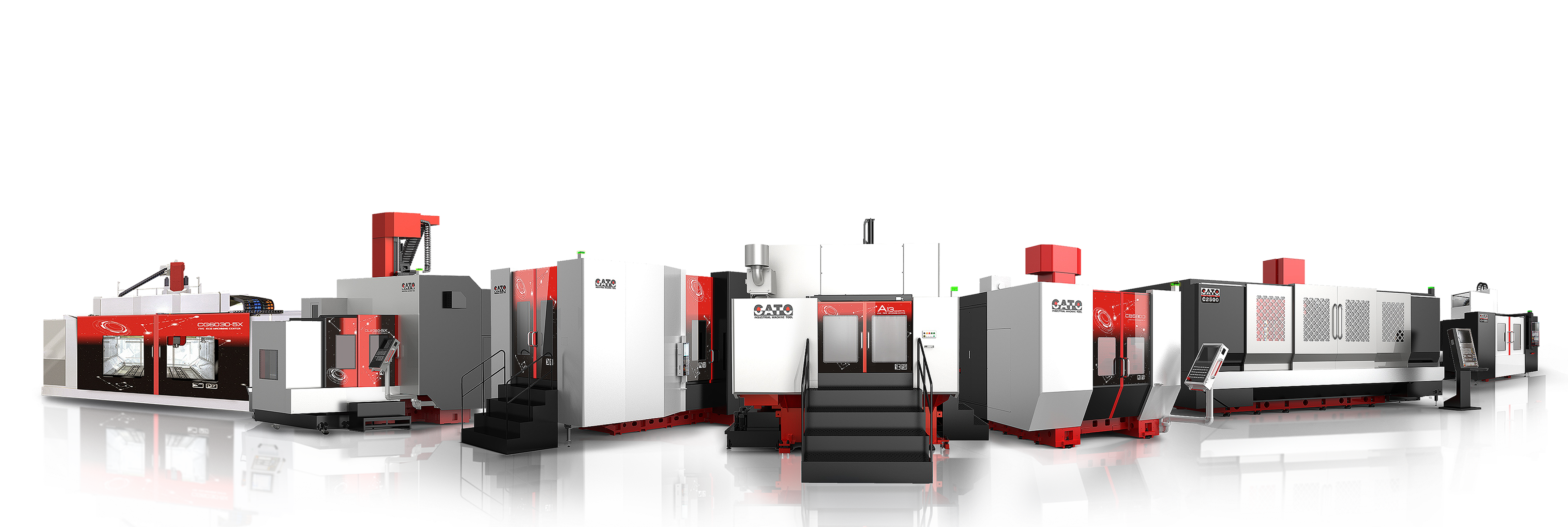
Full-Series Mass Production: The company's full range of gantry-type 5-axis, horizontal cradle 5-axis, and vertical 5-axis machines, all featuring integrated high-rigidity beds and symmetrical box-in-box structures, have optimized thermal deformation control, achieving over 80% self-sufficiency in machine integrity. Performance under heavy-duty cutting conditions is comparable to that of leading international equipment.
IV. Carrying the Banner of National Industry: A Core Force for High-End Domestic Substitution
At the industry level, CATO ranks among the top tier of domestic 5-axis machine tool manufacturers. It is one of the few Chinese companies that simultaneously possesses in-house developed CNC systems and the manufacturing capability for a full range of high-end 5-axis equipment, thus breaking the long-term foreign monopoly on high-precision machining equipment. Its contribution to national industry is threefold:
Securing the Strategic Industrial Chain: By providing comprehensive domestic machining solutions for aerospace, new energy vehicles, humanoid robotics, and medical devices, it frees the manufacturing of critical components from reliance on imported equipment.
Strengthening the Local Machine Tool Ecosystem: With its dual bases in Dongguan 、Ningxia and Changzhou, it drives the synergistic development of upstream and downstream industries like casting, servo systems, and precision transmissions.
Accelerating Domestic Substitution in the High-End Market: By offering equivalent precision, lower operational costs, and round-the-clock local service, CATO challenges the entrenched preference for imported machines among high-end manufacturers. It also collaborates with educational institutions to cultivate CNC talent, solidifying the foundation for industry innovation.


I dream of the vast landscape, and in the land of hibiscus, all is bathed in morning light. The seventy-year tumultuous journey of the machine tool industry, from the "Eighteen Arhats" laying the industrial foundation, to long-term subjugation to foreign core technologies, and now to the breakthrough led by specialized and sophisticated enterprises, is a true reflection of China's efforts to strengthen and supplement its manufacturing chain. Overcoming technological blockades is not the achievement of a single company, but CATO, by forging an integrated path of "in -house developed systems + core components + high-end 5-axis complete machines," has proven with its equipment performance that China is fully capable of manufacturing world-class industrial machine tools. Looking ahead, equipment manufacturers represented by CATO will continue to delve deep into underlying technologies, progressively narrowing the gap with top-tier overseas equipment. This will ensure that the lifeline of industrial machine tools remains firmly in Chinese hands, contributing "hardcore national machinery" to the building of a manufacturing powerhouse.

Key words:
Previous Page
Latest information

Official Wechat
Mobile phone official website
Online Message
Leave your contact information and needs, we will arrange for professionals to contact you
Quick Navigation
Contact Us
Add.: No.1, Dongye Road, Houjie Town, Dongguan City, Guangdong Province, China
Tel: +86-769-38825288
WeChat: CATO54321
Fax: +86-769-38825138
E-mail: marketing@catocnc.cn
Web: http://www.catocnc.com
Service Hotline: +86-400-680-6638